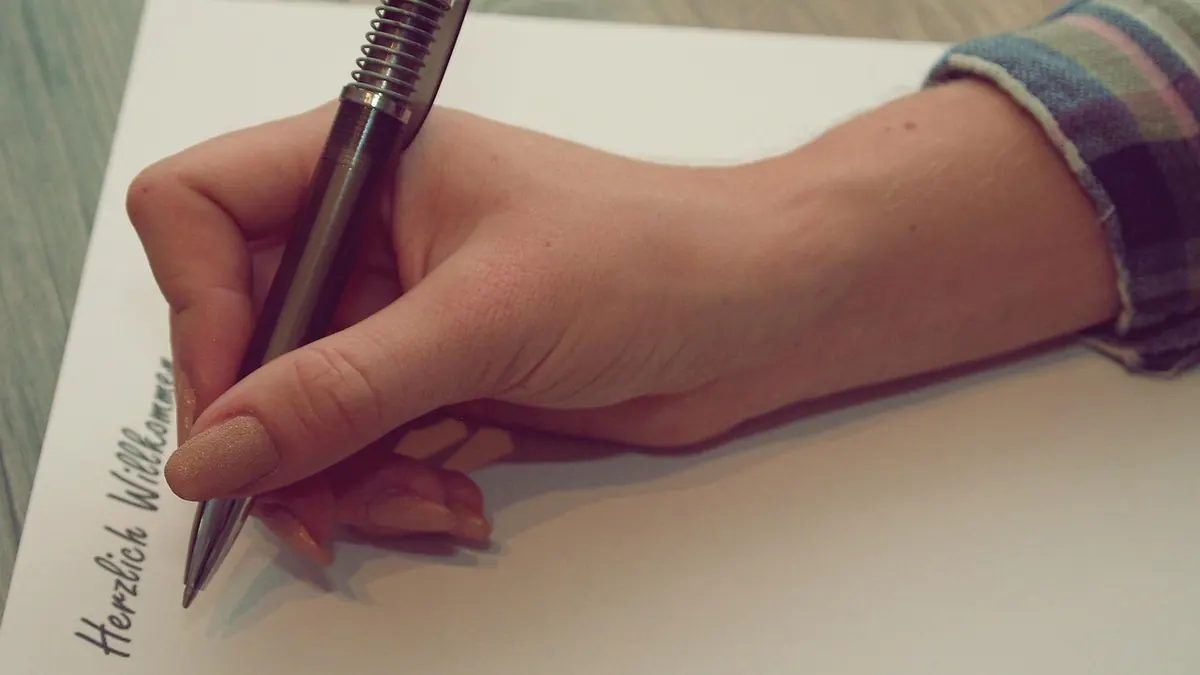
How to Keep a One-Line-a-Day Journal Without Falling Behind

A single line a day sounds like the easiest habit in the world until the third week, when you have missed four days and the blank page starts to feel like an accusation. The problem is rarely discipline. It is that nobody decided, in advance, what counts as done.
One sentence is a complete entry
A one-line journal is not a diary scaled down. It is a different form, and it works because the unit of effort is small enough to survive a bad week. Each entry is one sentence — occasionally two — written on or near the day it describes.
What you get back is a spine. Six months of lines can be read in ten minutes and still tell you what that spring was like. Six months of abandoned paragraphs tell you only that you once had good intentions.
How long is a line?
Long enough to hold a specific thought. Anything from five words to a full sentence or two, roughly the length of a text message you would actually send. If you find yourself writing five lines and calling it one, that is a fine habit — it just is not this one.
Attach it to a moment, not a mood
Habits that depend on feeling like it do not survive a Tuesday. Habits attached to something you already do survive almost anything. Choose a trigger you never skip: the kettle boiling, the train doors closing, the last light off downstairs.
Most people do best with one of three slots.
- First thing. Good if you want to set a tone, less good if you are groggy and write "tired" ninety times.
- Over lunch. A useful checkpoint. You still remember the morning, and the evening has not flattened it yet.
- Last thing at night. The most popular and the easiest to skip when you are exhausted. If you choose it, keep the notebook on the pillow, not in a drawer.
That last point matters more than it sounds. A journal kept in a drawer is a journal you will not open. Put the book where the moment happens and keep a working pen with it. A pen that has run out is a very small excuse and a very effective one.
Decide your catch-up rules before you need them
Ambiguity is what kills these habits, not missed days. Decide now, while the notebook is empty and you are feeling sensible, exactly what happens after a gap. Something like this works well:
- Miss one day. Write it tomorrow, in the same sitting as today's line. Two lines, thirty seconds, no guilt.
- Miss two or three days. Compress them into one line. "Three days of flu, toast and bad television" is a better record than three invented sentences.
- Miss a week or more. Do not catch up. Write today's line and note the gap honestly — "Gap, 12–19 March. Busy. No idea." Then carry on as if nothing happened, because nothing did.
- Never rewrite an old line. Apart from obvious typos, leave it. The awkwardness is part of the record.
Two small details make this easier. Date every line so the gaps are visible and honest. And write in ink: a pencil invites fiddling, while ink commits you to what you actually thought at the time.
What to write when nothing happened
Most days feel like nothing much, and "nothing much" is useless a year later. The line does not need to be interesting. It needs to be specific, because concrete detail is what makes an ordinary day retrievable.
When you are stuck, steal one of these:
- The thing that took up the most time.
- The weather, described properly. It is more evocative than you expect.
- Something someone said, in their words rather than your summary.
- What you ate that was worth eating, or the meal you would happily never see again.
- Something you noticed on the walk, the drive or the bus.
Compare these two entries for the same day:
Busy. Tired. Fine.
Forty minutes on the phone to a supplier who kept saying "bear with me". Leftover curry, standing up. In bed by ten, asleep by half past.
The second one has a voice. In two years you will remember the phone call and the curry. "Fine" will have dissolved completely.
Keeping it going on the days that go badly
On genuinely awful days, lower the bar rather than skip. A line can be three words. It can be one adjective and a full stop. Skipping once is fine; skipping twice starts the slow drift back to an empty notebook.
- Write it wherever you are. A note on your phone counts, as long as it reaches the page later. Empty the note into the journal weekly.
- Write before you take your shoes off. Do the line at the threshold, not after the sofa.
- Set one alarm. Label it with a question — "What happened today?" — rather than a command. Questions get answered; commands get dismissed.
- Accept a minimum of three words. "Cold. Long. Done." is a legitimate entry and takes four seconds.
Watch for two traps. Perfectionism is the first: the belief that a line must be well written. It does not; it must be true and dated. The second is turning the line into a to-do list. A journal records what happened, not what you failed to do. Keep the two separate and the habit stays pleasant.
Keep the rules small and read it back
The point of a one-line journal is not the writing. It is the rereading. Once a month, pour a cup of tea and read the last thirty lines in one go. You will spot a mood you did not notice at the time, a worry that lasted two days and vanished, a stretch of weeks that turned out better than it felt.
So keep it simple: one sentence, a fixed moment, a pen that works, and a catch-up rule you can follow when you inevitably miss a day. Let some lines be dull. That is what a real record looks like.
Photo: 6689062 / Pixabay